Write a book with AI: what actually happens

Writing a book with AI usually means writing it yourself with help. Fablemora does the whole job: it outlines the cast and the world, writes every chapter against that outline, illustrates it where the format needs pictures, has a second model read the finished book for contradictions, and typesets the result into three editions — a print-ready PDF with its full cover, an EPUB, and a narrated audiobook.

Made by Fablemora

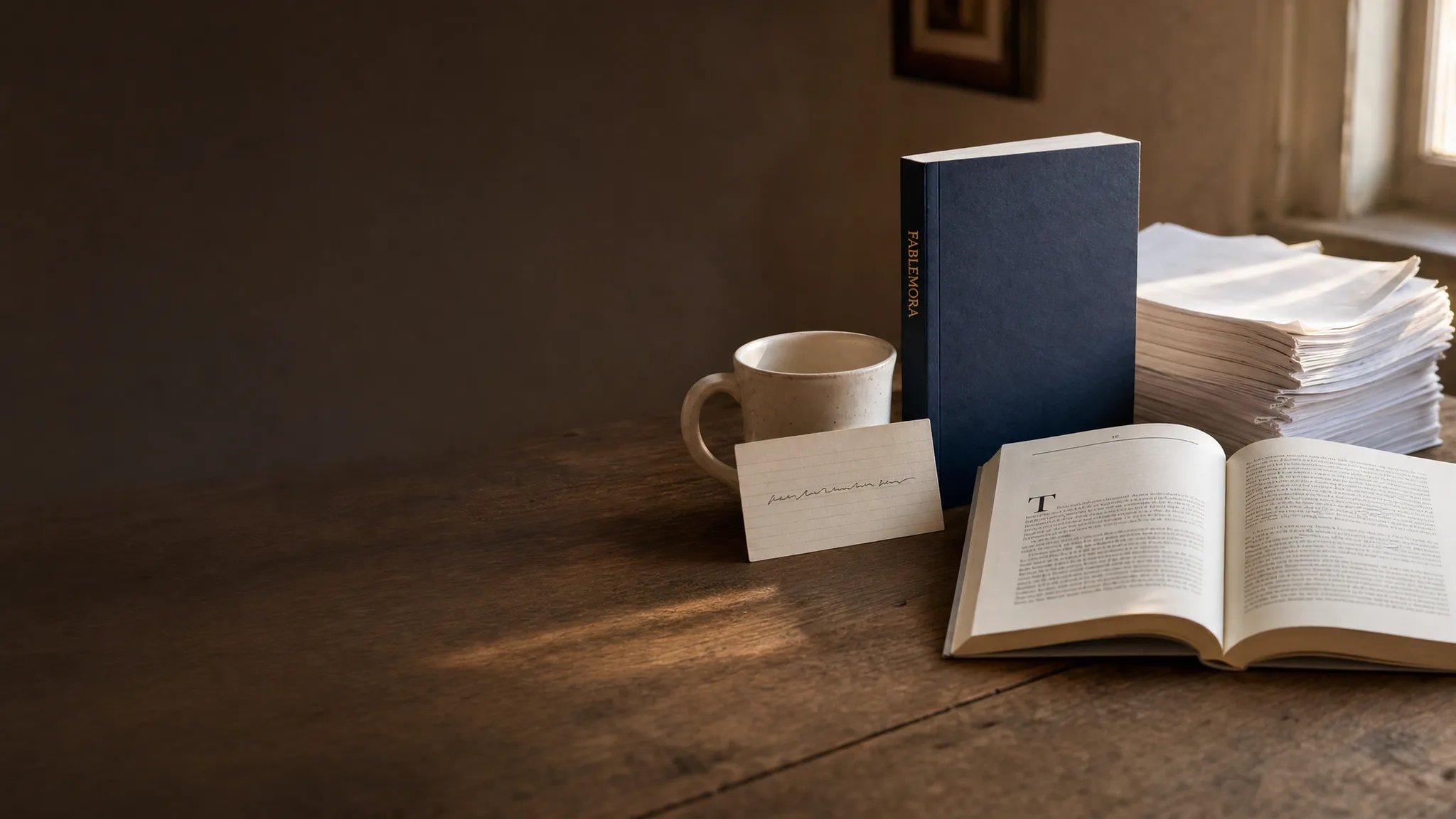
The Low-Tide Bell, made by Fablemora: its cover, and the book open at two of its pages

Using AI to write a book starts with the rules, not chapter one

Before a sentence of prose exists, the book has a set of rules: who the people are, where it happens, the voice it is told in, and the shape of the plot. That document is written first and everything afterwards is written against it.

This is the difference between a book and a pile of chapters. A model asked to continue from the previous chapter drifts, because each chapter is only ever checked against the one before it. A model writing against those rules has something fixed to be wrong about.

The book’s cast, island, narrative voice and plot shape are fixed on working leaves placed before its first manuscript page.

An AI book writer that reads its own manuscript back

The chapters are written in order, each against the outline. When the manuscript is finished, a separate model reads the whole thing looking only for contradictions — the eye colour that changed, the character who was in two places, the date that moved.

That check finds contradictions. It does not decide whether the book is good; nothing automated does, and a page that claimed otherwise would be lying to you.

Write a book using AI and get a book, not a document

The text is typeset: a measure sized to the trim, margins with a gutter that grows with the page count, running heads, proper chapter openers. The cover is built as a full wrap with the spine measured for the finished page count. The ebook is packaged and validated.

What you download is what a printer takes and what a store accepts, rather than a manuscript you now have to lay out yourself.

The completed novel appears as a properly typeset bound book, a measured full cover wrap, a folded print signature and an unabridged audiobook edition.

The sizes this kind of book usually is.

These are the trims a book like this is normally set at, and the studio starts from them. Pick any of them, or any of the others — the interior is typeset to whichever you choose and the cover is built around it, with the spine measured off the finished page count rather than estimated.

  1. 6 × 9″ (15.2 × 22.9 cm)

  2. 5.5 × 8.5″ (14 × 21.6 cm)

  3. 5 × 8″ (12.7 × 20.3 cm)

  4. 5.25 × 8″ (13.3 × 20.3 cm)

13 more sizes available — every trim works for every kind of book.

Before you start.

How long does the whole thing take?

Minutes for a short illustrated book; longer for a full-length novel. You watch each stage happen rather than waiting for an email.

Do I have to write anything myself?

No. One sentence is the input. You can change the outline before it writes, and the finished text afterwards, but nothing requires you to.

Who owns what it writes?

You do. One payment, no royalties, no licence to renew. You may sell the book.

Can I use it for non-fiction?

Yes. Nonfiction is one of the formats, and it is outlined and checked the same way fiction is.

What if I do not like what it writes?

The outline is shown before the book is built, which is the cheapest point to change direction. You can also rewrite the finished text — it is yours.

Write your book.

Describe it in a sentence. You will see the outline and the cover before anything is written.